Toca Boca Hair Salon 4 NETFLIX
- 4.5
- Rating
- 1.00M
- Installs
- Free
- Price
 Analysis by App-foxy
I approached Toca Boca Hair Salon 4 NETFLIX as a small creative studio rather than a game built around winning, collecting, or beating a clock. That distinction matters. This is an educational game from Netflix, Inc. focused on beauty makeovers, with the player taking the role of a hair stylist and makeup artist. After spending time with it, I found that its appeal comes from open-ended play: you experiment with a look, adjust it when it feels wrong, and enjoy the character you have created.
My first impression was that this is best understood as a relaxed creative activity for children, not a lesson-based course in cosmetology. It encourages choices and visual expression without making the player prove a skill level. That makes it easy to hand to a child who wants to play independently, while still giving a parent something concrete to discuss afterward: why a certain hairstyle works, how colors change an appearance, or what kind of look suits a particular character.
How to decide whether this makeover game fits
The most useful question is not whether the game has enough content to occupy someone for a long session. It is whether the player enjoys making visual decisions. A child who likes arranging colors, trying different hairstyles, and inventing characters will probably get more from it than a child who expects racing, puzzles with clear answers, or a traditional progression system.
You May Also Like

 Blood Strike: 2.5 Anniversary
Blood Strike’s Loadouts Turn Every Drop Into a Tactical Gamble
A close look at Blood Strike’s custom loadouts: how fast access to signature weapons reshapes its battle royale rhythm, rewards preparation, and narrows the gap between fights.

 Pandora - Music & Podcasts
Pandora’s Music Is Easy to Start, but Harder to Recover
Pandora’s strength is its low-effort path from a seed to a station. Its weak spot is how much confidence it asks you to place in connection, setup, and quiet recovery.

 8 Ball Pool
 Is Built on Rivalries, Rematches, and Routine
A close look at the rivalries, rematches, shared routines, and unanswered safety questions that turn a quick pool match into a persistent mobile community.

 Samsung Music
’s Quiet Strength Is Playing What You Already Own
Its reach comes less from spectacle than from dependable access to a personal library. That simplicity is both the app’s strongest retention engine and its ceiling.

 AccuWeather: Weather Radar
AccuWeather Review: A Quick, Clear Forecast for Everyday Decisions
For everyday plans, the best forecast is the one you can understand quickly. AccuWeather makes rain timing, radar, and local conditions easy to act on, with a few trade-offs.

 Hill Climb Racing
Why Hill Climb Racing Still Turns Crashes Into One More Run
A tiny car, a bumpy hill and one more upgrade: Hill Climb Racing keeps resurfacing because its simple chaos makes every near-miss feel personal.
More From Our News Desk



I would also consider the age range carefully. The content rating is Everyone, which matches the gentle, accessible tone I experienced. That does not mean every child will find it equally engaging. Younger players may enjoy the direct cause-and-effect of changing a look, while older children may want more detailed challenges or a stronger sense of advancement. The game works best when creativity itself is the reward.
Another decision point is the device. The game requires Android 8.0 or later, so anyone using an older Android phone or tablet should check compatibility before planning around it. On a suitable device, the touch-focused design feels much more natural on a tablet than on a cramped phone screen. A larger display gives children room to make careful selections and makes it easier for an adult nearby to see what they are doing.
The game is free, and its current version is 1.0. Those details make trying it a low-commitment decision, especially for families already using Netflix. I would still treat the first session as a test rather than assuming it will become a daily favorite. Creative games can be wonderfully replayable for one child and quickly lose their charm for another, depending on whether experimentation feels like play or simply repetition.
What the play experience is really asking you to do
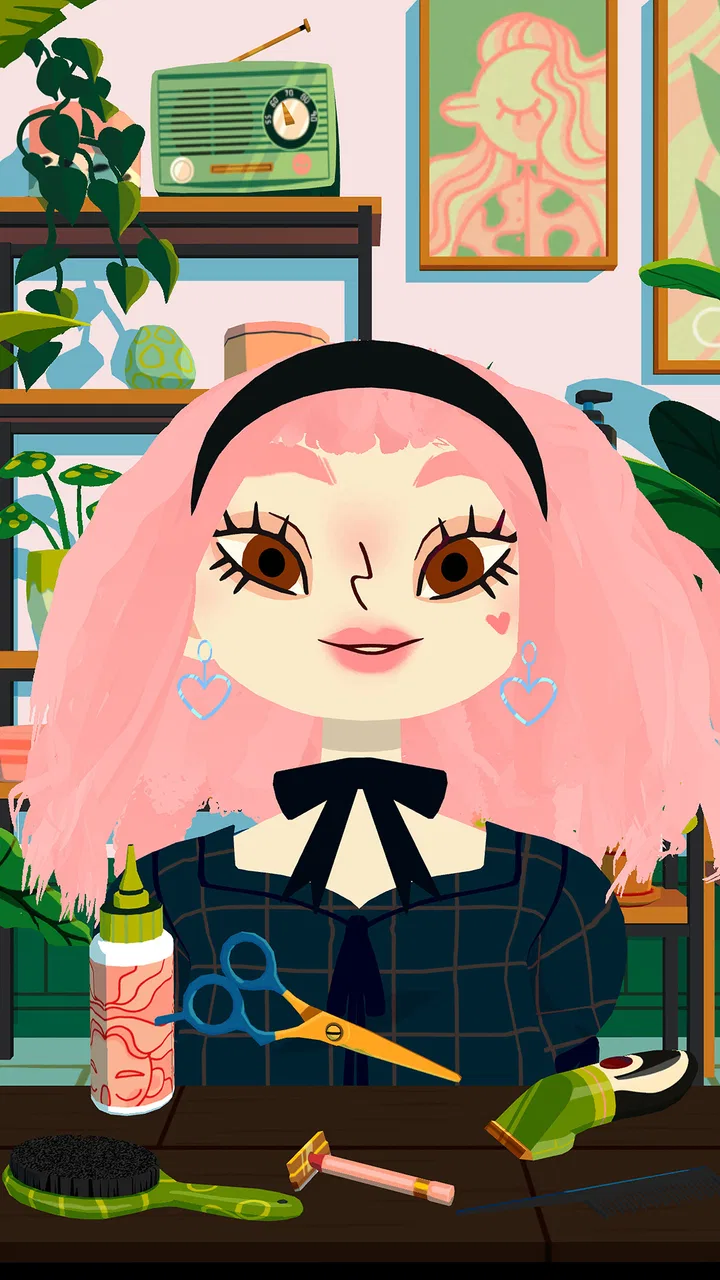
The central activity is transformation. You begin with a character and work toward a chosen appearance through hair styling and makeup decisions. I liked that the process feels more like a sketchbook than a checklist. There is room to pause, reconsider a choice, and follow an idea that was not part of the original plan.
That freedom is also the reason I would not recommend it to someone looking for explicit instruction. It may help a child notice combinations of shape and color, but it should not be mistaken for professional beauty training. The educational value is informal: observation, sequencing, personal taste, and confidence in making choices all appear through play rather than through explanations or tests.
A realistic use case is a short creative break after school. A child can sit with a tablet, create a look, and then show it to a parent or sibling. Instead of asking whether the result is “right,” the adult can ask what the child was trying to achieve. That turns a simple makeover into a conversation about intention and design without making the activity feel like homework.
Where it earns its strong reputation
The public response suggests that this approach is connecting with its audience: the game holds a 4.6 average from around 5,200 ratings, and it has passed 500,000 installs. I see those figures as useful context rather than a guarantee. They indicate that the concept has broad appeal, but the important question for an individual family remains whether open-ended styling is the kind of play they want.
Its biggest strength is accessibility. A child does not need to understand complicated rules before getting started. The theme is immediately clear, and the actions are easy to connect with the visible result. That low barrier is valuable for independent play because the child can focus on making choices instead of learning a complex interface.
I also appreciate the absence of pressure in the basic concept. There is no need to chase a score or compare a makeover with somebody else’s. For children who become frustrated by failure states, that can make the experience feel safer. They can try a bold combination, decide it does not work, and treat the mistake as part of the design process.
The most important strength is the freedom to revise an idea without turning the revision into failure. That is a small but meaningful difference from many children’s games. A child can learn that a first attempt is not final, which is a useful habit in drawing, dressing, decorating, and other creative activities.
Three ways to get more from each session
My first practical suggestion is to give the child a theme before opening the game, but keep it loose. “Create a look for a rainy-day concert” or “make something that feels cheerful” gives the session a starting point without dictating the answer. This makes the activity more purposeful and helps prevent random tapping from becoming the whole experience.
Second, encourage a before-and-after conversation rather than judging the finished character. Ask which choice changed the look most, which part was hardest to decide, and what the child would alter next time. This turns the makeover into a simple exercise in explaining choices. It is especially useful for children who enjoy showing their work but need help putting their creative process into words.
Third, use the game as a shared activity occasionally rather than leaving it permanently in the role of background entertainment. Take turns choosing a direction, or let the child style while the adult describes a fictional character. The game is more interesting when the makeover has a story behind it. That approach also reveals quickly whether the player enjoys imagination and experimentation or only wants a more structured challenge.
These suggestions are not extra game modes; they are ways of using the existing creative setup more thoughtfully. That distinction is important. Someone buying it in the hope of finding a deep beauty simulator may be disappointed, while a family looking for a friendly prompt for imaginative play may find it surprisingly useful.
Where another type of game may fit better
The usual alternatives fall into different groups, and each serves a different need. Puzzle games are better when a child wants clear goals and measurable solutions. Drawing apps are a stronger choice when the child wants complete control over a blank canvas. Dress-up games may suit players who care more about outfits and character presentation than the process of styling hair and makeup.
Compared with a drawing app, this game offers a more guided starting point. That can help a child who freezes when faced with an empty screen, but it also means the creative space is narrower. Compared with a competitive game, it is calmer and less demanding, yet it may feel too quiet for a child who thrives on speed, scores, or constant rewards.
I would also look elsewhere for a child who wants genuine educational structure. A language game, mathematics app, or science title normally explains a concept and checks understanding. Here, the learning is embedded in the act of choosing and refining a look. That is worthwhile, but it is a different kind of education and should be evaluated honestly.
Parents should skip it if the main requirement is a substantial progression system, challenging objectives, or a long-term mastery curve. The makeover theme can support repeated creativity, but repetition alone will not satisfy every player. If your child asks, “What do I unlock next?” or “How do I get a higher score?” this may not be the right match.
Small limitations that affect the decision
The open-ended format can create a motivation problem. Without a clear task, some children may make a few quick changes and stop. I found that the experience becomes stronger when there is a personal prompt or a conversation around the result. Left entirely without context, it can feel more like a brief toy than a complete game session.
The beauty theme may also be too narrow for some families. Hair and makeup provide plenty of room for visual play, but they naturally center appearance. If you are looking for an activity built around building, storytelling, music, or problem-solving, this focus may not hold attention for long. The game does not need to cover every kind of creativity, but its specialization is worth recognizing before installing it.
There is a trade-off between simplicity and depth. The approachable design is one of its best qualities, especially for younger players, but experienced players may want finer control or more demanding scenarios. I would not call that a flaw in isolation. It simply means the game is aimed at quick, friendly experimentation rather than technical simulation.
What switching to it involves
Because the game is free, the financial cost of trying it is low. The more relevant cost is attention. A family may spend time introducing it, exploring the makeover process, and deciding whether it deserves a place among the child’s regular activities. If the player already has a favorite dress-up or creative app, this one needs to offer a distinct mood rather than replace everything else.
The easiest transition is to use it as a complementary activity. Keep a drawing app for unrestricted creation, a puzzle game for focused problem-solving, and this title for character-based styling. That division gives each app a clear purpose and avoids expecting one simple game to satisfy every creative or educational need.
For households already familiar with Netflix, the developer connection makes the game feel like a natural addition to a broader entertainment setup. Still, I would judge it on the child’s response, not on the name attached to it. A recognizable developer can make a first try easier, but it cannot guarantee that the artistic theme will suit every player.
It is also worth checking the practical setup before a child begins. Make sure the device runs Android 8.0 or newer, choose a comfortable screen, and decide whether the first session will be independent or shared. Those simple choices affect the experience more than parents might expect. A child struggling to tap accurately on a small screen may appear bored when the real problem is the device.
Who should install it, and who should pass
I recommend it most strongly to children who enjoy makeovers as a form of storytelling. If your child likes to explain why a character has a certain style, experiments without worrying about perfection, or enjoys showing a finished creation, this game has a good chance of becoming a pleasant creative outlet.
It is also a good fit for parents who want a quiet, approachable activity that can be played alone or discussed together. The Everyone rating supports its broad accessibility, while the free price makes a trial straightforward. I would introduce it with a small creative challenge rather than presenting it as a game that must provide hours of continuous entertainment.
I would pass if your priority is academic instruction, competitive action, detailed simulation, or a strong reward ladder. A child who prefers solving problems to styling characters may find the experience too loose. Likewise, a player who wants a large world, varied missions, or constant novelty will probably be happier with a different category of game.
My recommendation after using it
My final view is positive but specific: this is a good educational creative game when you want gentle, appearance-focused experimentation rather than formal lessons or high-pressure gameplay. Netflix, Inc. has positioned it in a space where the simple act of changing a character can become a prompt for imagination, discussion, and personal expression.
The rating and install figures show that it has found an audience, but I would not choose it solely because it is popular. Choose it because the player enjoys hair styling, makeup, and visual makeovers. Start with a short session, give the child a theme, and watch whether they make deliberate choices or simply tap through the options. That first response will tell you more than any ranking.
For me, the deciding advantage is its welcoming creative loop: choose, see the result, rethink, and try again. Its deciding weakness is that the same freedom can feel thin without a story or prompt. If you accept that trade-off, the game is worth trying as a calm, free activity for an Everyone audience. If you need structure, challenge, or a broader educational purpose, keep looking at puzzle, drawing, or subject-focused alternatives instead.
FAQs for Toca Boca Hair Salon 4 NETFLIX
01What is Toca Boca Hair Salon 4 NETFLIX?
Toca Boca Hair Salon 4 NETFLIX is a creative and interactive app where users can experiment with hairstyles, colors, and accessories on virtual characters. Available through Netflix, it offers a premium experience without ads or in-app purchases. It's a fun way for both kids and adults to showcase their hairstyling creativity.
02Is Toca Boca Hair Salon 4 NETFLIX safe for children?
Yes, Toca Boca Hair Salon 4 NETFLIX is designed with children in mind, featuring a user-friendly interface and no ads or in-app purchases. The game encourages creativity in a safe, virtual environment, making it suitable for children aged 3 and up, under parental supervision.
03Do I need a Netflix subscription to use Toca Boca Hair Salon 4?
Yes, a Netflix subscription is required to access Toca Boca Hair Salon 4 NETFLIX. The app is part of Netflix’s growing library of interactive content, providing a seamless and ad-free experience for subscribers. Ensure your device is compatible with Netflix before downloading.
04What features does Toca Boca Hair Salon 4 NETFLIX offer?
The app includes a wide range of hairstyling tools, vibrant hair colors, and fun accessories to customize your characters. Users can wash, cut, style, and dye hair while experimenting with different looks. The app also offers unique animations and reactions from characters, enhancing the interactive experience.
05Can I play Toca Boca Hair Salon 4 NETFLIX offline?
No, an internet connection is required to access Toca Boca Hair Salon 4 NETFLIX. As it is part of Netflix’s interactive content, you must be online to stream and play the game. Ensure you have a stable internet connection to enjoy uninterrupted gameplay.
Pros
- Intuitive interface for all ages.
- Diverse hairstyles and tools.
- Regular updates with new content.
- No ads or in-app purchases.
- Creative and educational play.
Cons
- Limited character customization.
- Requires a stable internet connection.
- Some tools lack detailed instructions.
- Occasional minor bugs.
- May feel repetitive over time.

Toca Boca Hair Salon 4 NETFLIX
Gallery